When we hear the word “laser,” we might think of printers, barcode scanners, distance meters, DVD players, colorful security system beams, military technology, self-driving cars, hair removal, vision correction – or even the 1964 James Bond film Goldfinger, in which the hero is nearly sliced in half by a laser beam. To this day, laser-based innovations still feel quite futuristic, even though their theoretical foundations were laid over a century ago.


The foundations of laser technology were laid by Albert Einstein in 1917 in his study Zur Quantentheorie der Strahlung(“On the Quantum Theory of Radiation”). Building on Max Planck’s radiation theory, Einstein proposed that under certain conditions, light passing through a medium could not only weaken but also amplify. He theorized that electrons, which naturally absorb and emit light, could be stimulated to emit light at a specific wavelength, rather than randomly. This phenomenon – stimulated emission – was confirmed in 1928 and successfully demonstrated by 1947.
The first functioning laser device was created by Theodore Maiman on May 16, 1960. It consisted of a high-powered lamp and a synthetic ruby crystal coated with silver, which produced a red laser beam at a wavelength of 694 nanometers. Later that same year, the first infrared gas laser followed, and by 1962 the first semiconductor laser was developed – a type that remains the most common and essential form of laser today.
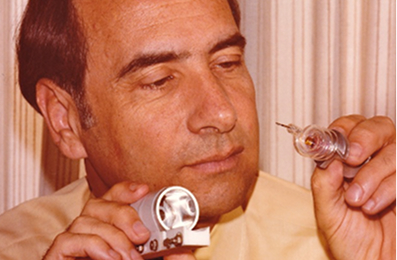
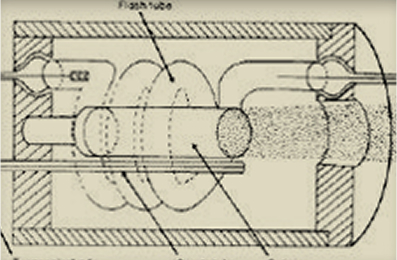
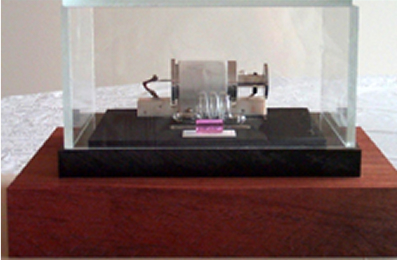
Although its practical applications were unclear at the time, the laser has since proven indispensable in our everyday lives. High-powered lasers (such as surgical lasers) capable of cutting human tissue appeared as early as 1965. Since then, laser technology has revolutionized medicine, therapy, and the beauty industry.Interestingly, natural lasers have also been discovered in recent decades – for example, in the atmospheres of Mars and Venus, where sunlight stimulates carbon dioxide to amplify infrared light, and in interstellar gas clouds across the universe.
Professor Endre Mester began studying the potential side effects of low-power (soft) lasers. Instead, he discovered the opposite: that “soft lasers” exert a biostimulating effect on living tissues.
The essence of this discovery is that when cells and tissues are exposed to soft laser light, they regenerate more quickly. For example, wound healing speeds up. Laser light stimulates the creation of new cells, tissues, and even new capillaries.
In the late 1970s, a research group composed of Hungarian physicists and medical doctors discovered that the beneficial biostimulatory effects were closely related to the polarization of laser light.
Since lasers at the time were very expensive, inefficient, and even dangerous to the human eye, this research group developed a much cheaper and eye-safe “ordinary” lamp, whose light was polarized. This became the predecessor of today’s polarized light therapy lamps – such as the BIOPTRON lamp.
The following 30 years of success in light therapy clearly demonstrated how beneficial polarized light is for the human body.


However, the recently developed semiconductor lasers are now more powerful, more efficient, and more affordable than polarized light lamps – though they are still dangerous to the human eye.
Therefore, after several years of research and development, in 2012, laser physicist Dr. Károly Rózsa – Doctor of the Hungarian Academy of Sciences – created a special “soft laser” that is safe for the human eye. This breakthrough made it possible to replace polarized light lamps with a much more effective device for those seeking healing.
Safe Laser Technology has essentially “tamed” the laser and ensures safe and easy use at home. The Safe Laser 1800 Infra, Safe Laser 500 Infra, and Safe Laser 150 represent a whole new era in the history of soft laser therapy treatments.
Research on soft lasers is ongoing, and it is expected that in the future, the range of diseases and conditions that can be safely and effectively treated at home without side effects using Safe Laser Technology will continue to grow.
A legjobb élmény biztosítása érdekében olyan technológiákat használunk, mint például a sütik (cookie-k), az eszközinformációk tárolására és/vagy elérésére. Ezen technológiák elfogadása lehetővé teszi számunkra, hogy olyan adatokat dolgozzunk fel ezen az oldalon, mint a böngészési szokások vagy az egyedi azonosítók. A hozzájárulás megtagadása vagy visszavonása hátrányosan befolyásolhat bizonyos funkciókat és szolgáltatásokat.
Ön sikeresen feliratkozott.
